Flexible versus structured
A workout builder for instructors that allows flexible workflows.
Challenge
Instructors are used to building training programs freely, using tools like Google Sheets or paper, with complete flexibility in exercise names and program structure.
Our product and the gym need a platform that enables tracking, reporting, and future automation.
The challenge was to create a program builder that preserves business-level control in the system while remaining flexible enough not to disrupt the instructor’s workflow.
Approach
Designed a workout builder that led to adoption by trainers while preserving the business’s need for structure.
Collaborated with psychologists, physiologists, and trainers to map common workflows, domain terminology, and pain points, and with the CTO to align the design with the underlying program logic.
Prototyped at low and high fidelity using complex scenarios, mid-build edits, mixed exercise types, and cross-section navigation to surface ambiguities before development.
structures and combinations
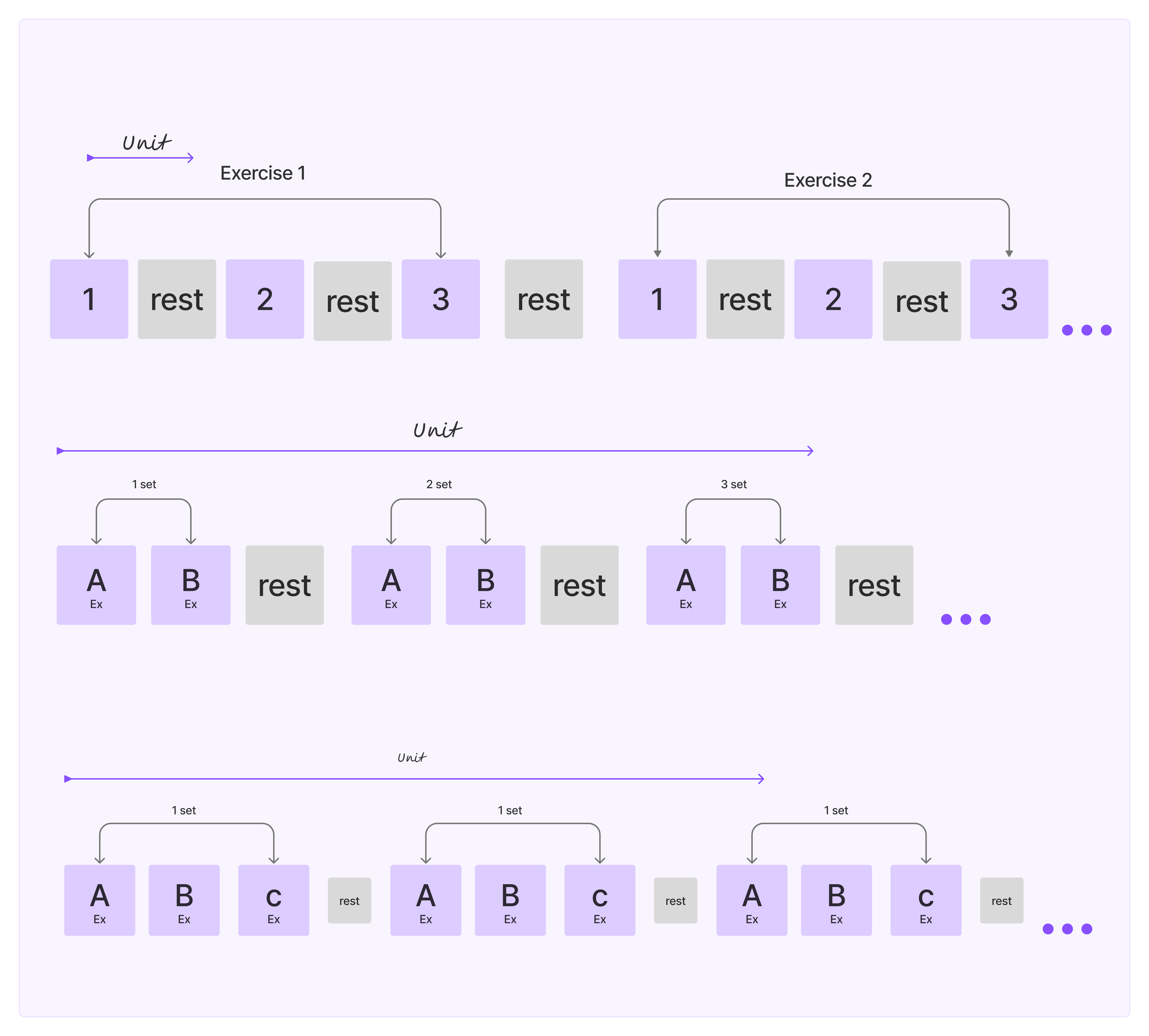
The system supports three exercise combinations: sets, supersets, and tri-sets grouped within a workout, across both web and mobile.
The solution was to define a small set of reusable building blocks (exercise + rest) and combine them differently for each structure, keeping the same mental model across platforms and reducing development overhead.
Combinations: from wizard flow to inline builder
Early on, creating a superset or tri-set required moving through a separate wizard, a linear flow that didn’t match how trainers naturally work, creating friction and reducing adoption.
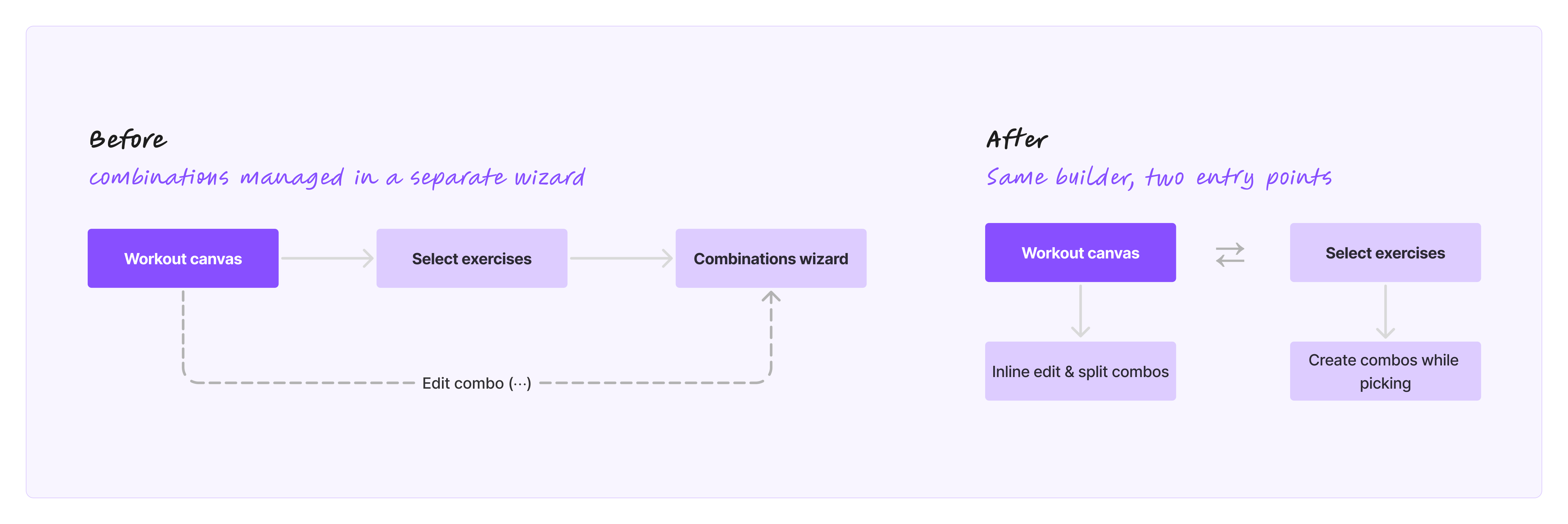
After the redesign, combinations are built and edited directly within the main canvas, without leaving the flow from the exercise selection screen or inline on the workout builder.
Research
Collaborated with an expert team of psychologists, physiologists, and trainers to understand the domain and how programs are built in practice.
Mapping
Mapped exercise types, program structures (singles, supersets, tri‑sets), and the parameter space (reps, time, resistance, rest) to define what the system needed to support over time.
Prototyping
Prototyped at low and high fidelity, testing complex program‑building flows with multiple parameter types and mixed exercise types.
Testing
Used complex user scenarios — navigating between sections, combining exercise types, editing mid‑build — to surface ambiguities and ensure consistent behavior.
Handoff
Worked closely with the CTO from problem framing through implementation to align the underlying program logic and data model.
Key Design Decisions
Visible structure from the start
The builder displays a structured workout from the outset, giving trainers a clear starting point while supporting adoption.
Naming and order remain editable, balancing trainer flexibility with the structure the business needs for reporting.
Structure for the system, freedom for the user
To preserve flexibility without breaking the underlying data model, an “All” library was introduced, letting trainers select any exercise across categories and adapt it to any workout structure, without compromising system integrity.
Favorites instead of custom exercises
Instructors needed a way to personalize their exercise library to work efficiently. Custom exercises were deferred because the system risk wasn’t justified at the early-stage startup.
The solution was to enable trainers to mark exercises as favorites, creating a personal library on top of the shared one without touching the system structure.
Impact & outcomes
Designed and shipped a program builder from scratch that balances user needs with business needs.
The builder supports complex program structures across multiple parameter types, an “All” library for cross-category exercise selection, and a Favorites layer for personalization, all within a single underlying data model built in close collaboration with the CTO.